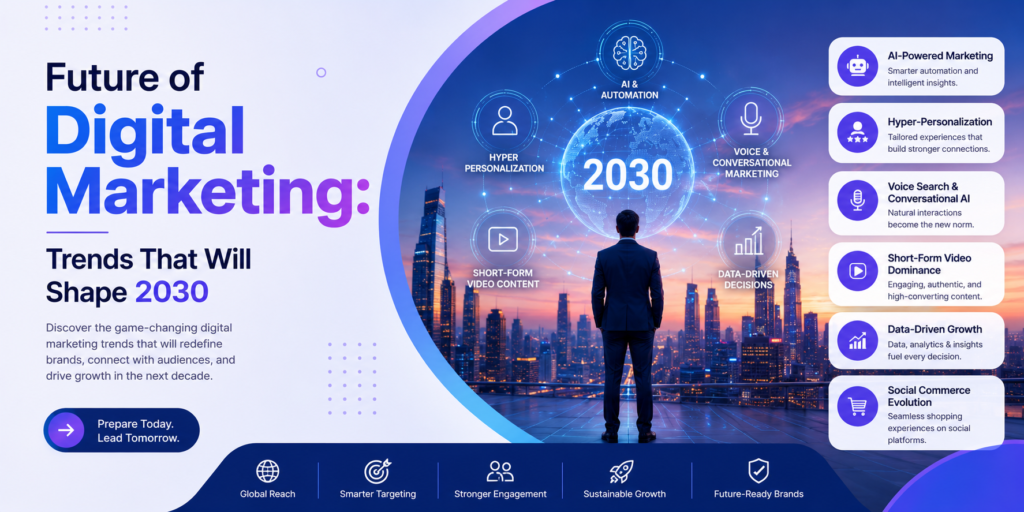
Digital marketing has transformed dramatically over the past decade, and the pace of innovation continues to accelerate. Technologies such as artificial intelligence, automation, voice search, and immersive digital experiences are changing how businesses connect with customers. As consumer expectations evolve and new platforms emerge, marketers must adapt their strategies to remain competitive.
By 2030, digital marketing will be more intelligent, personalized, and data-driven than ever before. Businesses that embrace innovation early will be better positioned to attract customers, build stronger relationships, and achieve sustainable growth. At the same time, marketers will need to balance technological advancements with transparency, privacy, and ethical practices.
This article explores the major digital marketing trends expected to shape the industry by 2030 and explains how businesses can prepare for the future.
1. AI-Powered Marketing Will Become the Standard
Artificial Intelligence (AI) is already transforming digital marketing, but by 2030 it will become an essential part of nearly every marketing activity. Businesses will use AI to automate repetitive tasks, analyze customer behavior, create personalized content, and optimize advertising campaigns in real time.
Expected Impact
1. Faster campaign creation and optimization
2. AI-generated content with human oversight
3. Predictive customer behavior analysis
4. Automated customer support through intelligent chatbots
5. Smarter audience targeting
Why It Matters
AI will help marketers improve efficiency while delivering more relevant experiences to customers. Businesses that integrate AI into their marketing strategies will gain a significant competitive advantage.
2. Hyper-Personalization Will Drive Customer Engagement
Consumers increasingly expect brands to understand their preferences and provide personalized experiences. By 2030, personalization will extend far beyond using a customer’s name in an email.
Businesses will leverage customer data, browsing behavior, purchase history, and AI-powered insights to deliver highly relevant recommendations, offers, and content across every digital touchpoint.
Expected Impact
1. Personalized website experiences
2. Dynamic email marketing campaigns
3. Individualized product recommendations
4. Customized advertising
5. Improved customer loyalty
Why It Matters
Customers are more likely to engage with brands that provide relevant and meaningful experiences, leading to higher satisfaction and stronger long-term relationships.
3. Voice Search and Conversational SEO Will Continue to Grow
The increasing use of voice assistants and smart devices is changing how people search online. Rather than typing short keywords, users are asking complete questions using natural language.
Businesses will need to optimize their websites for conversational search queries and featured snippets to remain visible in voice search results.
Expected Impact
1. Greater focus on long-tail keywords
2. Increased importance of local SEO
3. More conversational content
4. Growth of FAQ-based content
5. Enhanced mobile optimization
Why It Matters
Optimizing for voice search will help businesses reach users who rely on smart speakers, smartphones, and voice-enabled devices.
4. Immersive Marketing Through AR and VR
Augmented Reality (AR) and Virtual Reality (VR) are expected to become more accessible by 2030. These technologies will allow businesses to create interactive experiences that help customers explore products before making purchasing decisions.
Examples include virtual product demonstrations, digital showrooms, and interactive brand experiences.
Expected Impact
1. Virtual product trials
2. Interactive shopping experiences
3. Immersive brand storytelling
4. Enhanced customer engagement
5. Increased purchase confidence
Why It Matters
Businesses that adopt immersive technologies can provide memorable customer experiences that strengthen brand loyalty and improve conversion rates.
5. Privacy-First Marketing Will Build Customer Trust
Consumers are becoming increasingly aware of how their personal information is collected and used. At the same time, governments continue introducing stronger privacy regulations.
By 2030, businesses will need to rely more on first-party data while maintaining transparency about data collection practices.
Expected Impact
1. Greater use of first-party data
2. Clear consent management
3. Ethical data collection
4. Privacy-focused advertising
5. Stronger customer trust
Why It Matters
Brands that prioritize transparency and data protection will build stronger relationships with customers and improve long-term credibility.
6. Short-Form Video Will Remain a Powerful Marketing Tool
Video content has become one of the most engaging forms of digital communication. Platforms focused on short-form video continue to influence purchasing decisions and brand awareness.
Businesses will increasingly invest in educational videos, product demonstrations, behind-the-scenes content, and customer testimonials.
Expected Impact
1. Higher social media engagement
2. Increased video-based advertising
3. Better product education
4. Improved audience retention
5. Stronger brand awareness
Why It Matters
Video content captures attention quickly and allows brands to communicate complex ideas in an engaging format.
7. Marketing Automation Will Become More Intelligent
Automation tools will continue evolving, allowing marketers to manage customer journeys more efficiently.
Instead of automating individual tasks, businesses will automate entire marketing workflows, including lead nurturing, email campaigns, customer segmentation, and performance reporting.
Expected Impact
1. Automated customer journeys
2. Smarter email campaigns
3. Improved lead management
4. Real-time campaign optimization
5. Increased operational efficiency
Why It Matters
Automation enables businesses to deliver consistent customer experiences while reducing manual effort.
8. Data Analytics Will Drive Better Decision-Making
Data will remain one of the most valuable assets for marketers. Businesses will increasingly rely on predictive analytics, customer insights, and performance dashboards to make informed decisions.
Marketing success will depend on understanding which channels, campaigns, and content generate the highest return on investment.
Expected Impact
1. Better campaign optimization
2. Accurate customer insights
3. Improved budget allocation
4. Enhanced marketing ROI
5. Faster decision-making
Why It Matters
Data-driven marketing reduces guesswork and allows businesses to continuously improve their strategies.
9. Influencer Marketing Will Focus on Authenticity
Consumers are placing greater value on genuine recommendations rather than celebrity endorsements alone.
Brands will increasingly collaborate with niche creators, industry experts, and micro-influencers who have highly engaged communities.
Expected Impact
1. Authentic brand partnerships
2. Higher audience trust
3. Improved engagement rates
4. Better campaign performance
5. Community-driven marketing
Why It Matters
Authentic relationships between creators and audiences often generate stronger results than traditional advertising.
10. Omnichannel Marketing Will Become Essential
Customers interact with brands through websites, search engines, social media, mobile apps, email, messaging platforms, and physical stores.
By 2030, businesses will need to deliver a consistent experience across every customer touchpoint.
Expected Impact
1. Unified customer experiences
2. Consistent brand messaging
3. Improved customer retention
4. Better cross-channel analytics
5. Higher customer satisfaction
Why It Matters
Customers expect seamless experiences regardless of how they interact with a business.
How Businesses Can Prepare for 2030
Businesses should begin preparing for these changes today by:
1. Investing in AI-powered marketing tools
2. Prioritizing customer privacy and data security
3. Creating high-quality content
4. Improving website performance and SEO
5. Learning data analytics
6. Adopting marketing automation
7. Experimenting with emerging technologies
8. Building long-term customer relationships
Conclusion
The future of digital marketing will be shaped by innovation, personalization, automation, and trust. Technologies such as artificial intelligence, voice search, augmented reality, advanced analytics, and marketing automation will redefine how businesses connect with customers over the next decade.
However, technology alone will not guarantee success. Businesses that combine innovation with valuable content, ethical marketing practices, and customer-focused strategies will be best positioned to thrive in the digital landscape.
As we move toward 2030, marketers who continue learning, adapting, and embracing new technologies will be able to build stronger brands, deliver exceptional customer experiences, and achieve sustainable business growth in an increasingly competitive digital world.
Frequently Asked Questions (FAQs)
1. What is the future of digital marketing by 2030?
Digital marketing will become more AI-driven, personalized, privacy-focused, and automated, with greater emphasis on data analytics, voice search, and immersive customer experiences.
2. How will AI impact digital marketing?
AI will automate content creation, customer support, campaign optimization, audience targeting, and marketing analytics, helping businesses improve efficiency and deliver personalized experiences.
3. Will SEO still be important in 2030?
Yes. SEO will remain essential, but it will evolve to focus more on user intent, conversational search, high-quality content, technical performance, and AI-enhanced search experiences.
4. Why is privacy-first marketing important?
Consumers increasingly value transparency and data protection. Businesses that respect customer privacy and use ethical data practices will build stronger trust and long-term loyalty.
5. How can businesses prepare for the future of digital marketing?
Businesses should invest in AI tools, strengthen their SEO strategy, adopt marketing automation, improve data analytics capabilities, embrace omnichannel marketing, and continuously adapt to emerging technologies.